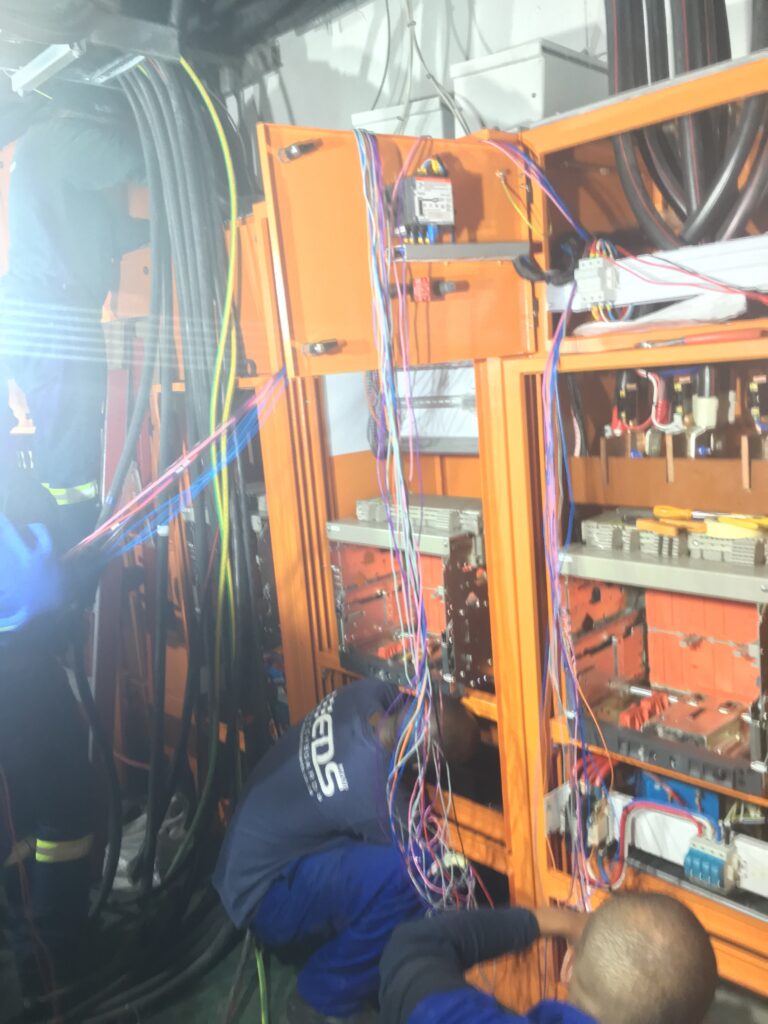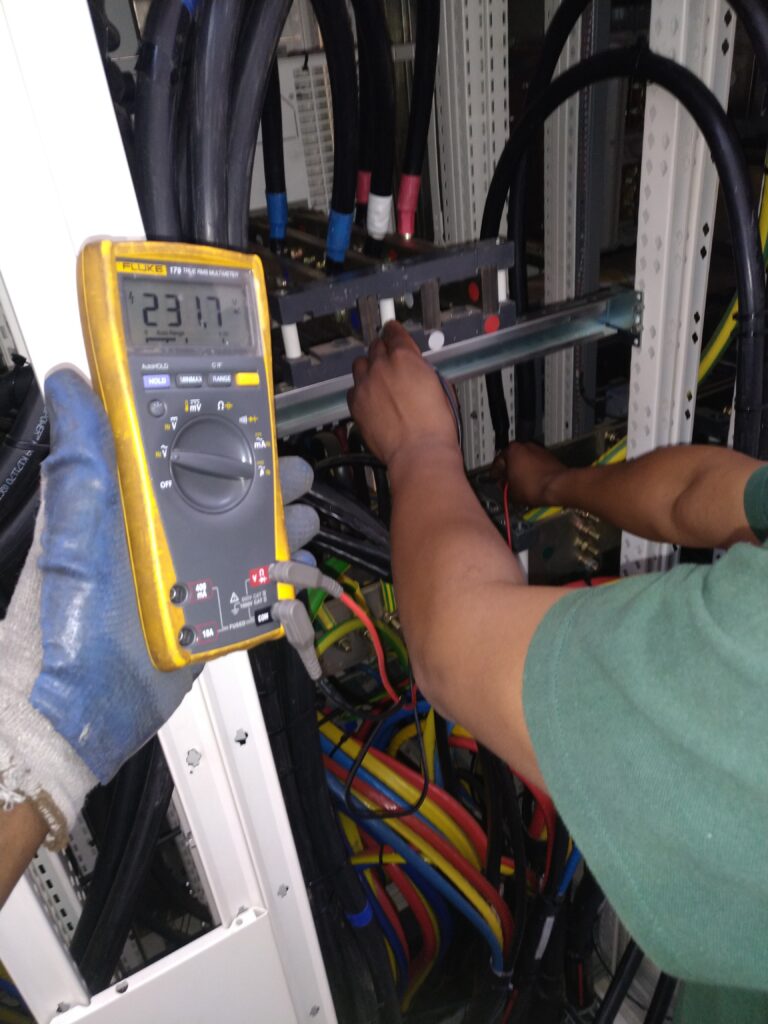
Tier 3 means concurrently maintainable. Every critical component has a redundant counterpart that is already running and capable of carrying the full load. You can take any single component offline for maintenance without affecting the facility’s uptime.
 What this means in practice is that if you have two UPS systems each rated at 200 kilowatts, and the facility load is 200 kilowatts, each UPS must be running at 50% of its capacity during normal operation. If one UPS needs to come offline, the other picks up the full 200 kilowatts without any manual switching, without any perceptible change to the tenants, and without the facility dropping below its tier standard during the maintenance window.
The same principle applies to chillers, generators, and cooling towers. You need enough redundancy that any single component can be taken out of service without the remaining components running above their safe operating capacity. A facility with two chillers, each running at 90% capacity to carry the full load, does not have genuine Tier 3 cooling redundancy because if one chiller fails, the remaining chiller cannot carry the load. The design meets the letter of dual-component redundancy but not its spirit.
“When it says Tier 3, in layman’s terms, the system is concurrently maintainable. You can do maintenance on a system while it is running without affecting it. So you always have a redundant path. For everything.” (Nathan Chirwa, Director, Boron Facilities Management).
What happens when a facility slips out of tier compliance without realising it?
The moment any redundant component is offline for any reason, the tier rating is temporarily compromised. The facility is operating without its safety net, and any further failure during that window has no fallback.
This is the scenario that a sound maintenance programme is designed to prevent. If a chiller is offline for maintenance, the maintenance window should be scheduled at a time when the remaining chiller capacity is sufficient to carry the full load with thermal reserve. If a UPS is offline for battery replacement, the transfer to the redundant UPS must be tested, not assumed. If a generator is offline for service, the service window should be during a period of low outage probability, and the remaining generator must be tested under full load before the maintenance window opens.
Facilities that schedule maintenance visits on calendar dates without reference to the facility’s current operational state are at risk of creating exactly this scenario. A monthly visit on the first Tuesday regardless of what else is running, is an administrative schedule, not an engineering one.
“In my 22 years of managing data centres, we have not once come to a point where we risked the tiering oversight. That’s why we have an in-house engineer who does the tiering. He stresses to us: this site is certified for Tier 3, and we need to maintain it as a Tier 3.” (Nathan Chirwa, Director, Boron Facilities Management)
The scalability design mistake that creates the most expensive preventative maintenance problems
The most common and most expensive problem Boron finds when auditing existing facilities is not ageing equipment or deferred maintenance. It is equipment that was sized correctly for the original load and is now approaching or exceeding its rated capacity because the load grew without a corresponding infrastructure upgrade.
The scenario plays out the same way across many different facilities. A data centre is designed for 200 kilowatts. The UPS is sized at 200 kilowatts. The cooling plant is sized for 200 kilowatts. Two years later, the facility has taken on additional tenants, and the load has crept to 240 kilowatts. The UPS is now running at 120% of its design capacity, which means any load spike pushes it into bypass mode. The cooling plant is struggling to maintain the supply temperature that the equipment requires. The redundancy that was built in at 200 kilowatts no longer functions as designed at 240 kilowatts.
The engineering fix is to design the core infrastructure for the load you expect to reach within five years, and to install only the components you need for the current load. A transformer can be rated for 500 kilowatts while the connected load is 200 kilowatts. When the load grows, the transformer does not need to be replaced. Cabling can be sized for future load. The modular UPS architecture discussed earlier allows capacity to be added in increments without infrastructure changes. The capital cost of this approach at design time is a fraction of the cost of infrastructure replacement at full load in a live facility.
The relevant compliance frameworks are: the Uptime Institute tier certification standards, the Occupational Health and Safety Act (Act 85 of 1993) as it applies to electrical and mechanical work on occupied facilities, SANS 10142 for electrical installations, the SANS 10400 series for building and fire safety requirements, and ISO 9001:2015 as the quality management standard against which a maintenance provider’s processes should be audited.
ISO 14001:2015 and ISO 45001:2018 are relevant to the environmental and occupational health management systems of any provider doing maintenance work on a facility.
A provider certified against all three of these standards through an accredited certification body has had their quality, environmental, and safety management systems independently assessed. That assessment is different from the provider having written a policy document. An audit certificate means the processes have been observed in operation and found to conform to the standard.
Boron Facilities Management holds ISO 9001:2015, ISO 14001:2015 and ISO 45001:2018 certification as an Integrated Management System through QAS International, issued in June 2026 and valid to June 2027. Certificate number SAP1021IMS. CIDB Grade 5EB (Electrical) and 5ME (Mechanical). Level 1 B-BBEE. Uptime Institute Tier Designer accredited.
How to conduct a preventative maintenance audit for a South African server room or data centre
A preventative maintenance audit has two phases: a document review and a physical inspection. The document review covers the maintenance log, the service interval schedule, the equipment register, the last generator load bank test result, and the last UPS battery inspection report. The physical inspection covers every critical component against the findings in the document review.
The most revealing part of a takeover audit is the comparison between the maintenance log and the equipment runtime data. If the log shows a generator was serviced six months ago but the hour meter shows 900 hours of runtime since that service, the service interval has been missed in practice even if it appeared on the schedule on paper. If the log shows quarterly UPS battery inspections but the internal resistance measurements were not recorded, the inspection was visual only and cannot confirm battery bank performance under load.
A professional FM audit firm produces a written report that covers each infrastructure layer, rates the condition of each system against its design specification, identifies deferred maintenance and its risk classification, and provides a prioritised capex list for remediation. That report is useful to the facilities manager, to the financial director who needs to budget for infrastructure maintenance, and to the insurance underwriter who needs to assess risk exposure.
Benefits of hiring a professional FM audit firm in South Africa
The primary benefit is independence. An audit produced by the same provider responsible for the maintenance programme has a structural conflict of interest. An audit produced by a different, qualified provider gives the client a view of the facility’s condition that is not influenced by the commercial relationship with the incumbent maintenance contractor.
The secondary benefit is qualification. Not every FM audit firm has CIDB-graded engineers on the team or ECSA-registered professionals making the technical judgements. An audit conclusion that “the UPS is in good condition” from a team without formal electrical engineering credentials is not the same as the same conclusion from a team with a professional engineer who carries personal liability for the assessment. For facilities under SLA contracts with financial penalty clauses, the qualification level of the audit team directly affects how much weight the audit findings carry in any subsequent commercial dispute.