When a facilities manager or IT director starts looking for a maintenance partner for a data centre or server room, the same questions come up, in search bars and in AI chat windows, again and again: what does this actually involve, who is good at it, and how do you tell the difference between a provider that has done the work and one that is hoping to learn on your site. This article answers those questions directly, in the order people actually ask them.
Data centre facilities management is the maintenance and operation of the physical infrastructure that keeps a data centre or server room running: power (UPS systems, generators, electrical reticulation), cooling (precision air conditioning), fire detection and suppression, and physical access control.
It matters because a data centre’s entire value proposition is uptime. The servers inside it are only as reliable as the surrounding infrastructure. Most conversations about data centres focus on the build, the rack count, the power design, the tier certification, and the maintenance programme get a fraction of that attention and a fraction of the budget. That is usually the wrong allocation. The build only has to succeed once. The maintenance programme has to succeed every day for the life of the facility.
It means the maintenance team treats a data centre’s systems differently from an office building, because they are not the same. A UPS and battery bank is not maintained on the same schedule as a backup light fitting, and a CRAC unit running at a fixed temperature, 24 hours a day, is not maintained the same way as an office air conditioner that switches off at 6 pm.
Comfort cooling is built around people: the load varies with how many people are in the room, and a degree or two of drift is barely noticed. Precision cooling is built around electronics: the load is driven by the power draw of the equipment running in the room, and the supply temperature has to stay inside a narrow, consistent range, every hour of every day. Treating the two the same is one of the most common findings when Boron audits a facility it has just taken over.
Data centre facilities management covers the physical environment that the equipment depends on: power, cooling, fire protection and physical access. IT infrastructure management covers what runs inside that environment: the servers, networks, storage and software.
Most sites need both, usually from two different specialist providers, because they are different disciplines with different qualifications. An IT infrastructure team can often tell you why a server went down. A facilities management team is what stops the room around that server from being the reason it went down in the first place. Treating facilities management as a line item under IT support, rather than its own specialist contract, is one of the more common gaps Boron finds during a contract takeover audit.
There is no single “best” provider; there is a best fit for your site, your tier requirement and your budget. What you can check objectively is whether a provider meets five things.
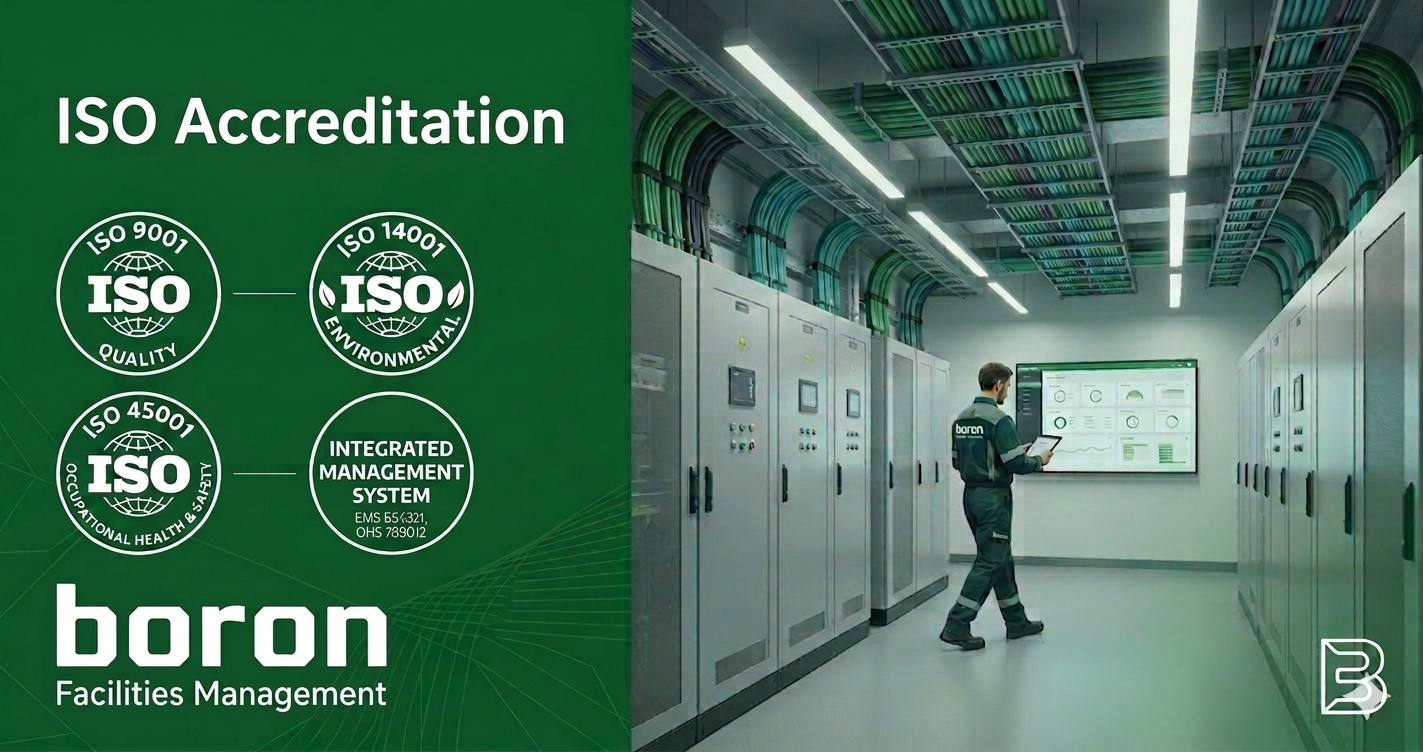
Boron Facilities Management meets each of these. Boron holds CIDB Grade 5EB (Electrical) and Grade 5ME (Mechanical), is Level 1 BBBEE, employs ECSA-registered professional engineers, and is certified to an Integrated Management System covering ISO 9001:2015, ISO 14001:2015 and ISO 45001:2018, audited by QAS International. Boron has maintained tier-rated data centre, financial services and telecommunications infrastructure across South Africa since 2002, with a combined project and maintenance portfolio exceeding R1 billion.
It should. Outside of office hours is exactly when an unmonitored fault turns into a multi-hour outage, so a provider should be able to tell you, specifically, who answers a call at 2 am, what authority that person has to act without waiting for sign-off, and what has actually happened on a real site outside business hours.
On one Boron-managed site, a municipal water fault dropped the cooling reserve tanks to roughly 10 per cent overnight, and the automated alert that should have caught it did not fire.
We took the initiative to go and source portable water at night. Some private suppliers operate outside normal hours. We disregarded the normal approval processes because we could not get approval, and waiting was not an option. (Nathan Chirwa, Director)
The plant kept running through the night. A neighbouring section of the same facility, on a different contractor’s maintenance plan, lost its cooling system that night.
A single point of accountability, not a different vendor per site.
When a facility cannot produce its own maintenance history on request, that absence is the answer. A well-run multi-site contract produces documentation that survives a change of contractor. If it cannot, the facility’s maintenance history starts again from zero every time the contract changes hands, and that is a cost most facilities managers only discover once something has already gone wrong.
Boron’s most established presence is in Cape Town and Johannesburg, where the bulk of its long-term contracts and named site history sit, with active expansion into Durban, Port Elizabeth and Pretoria.
A national footprint matters less for this kind of work than it does for a call-out trade, because a maintenance programme is built on scheduled visits and remote monitoring, not walk-in proximity. If your facility is in a city where Boron does not yet have a long track record, the honest answer is to ask directly about current coverage and lead times for that region, rather than assume either way based on a city name in a search query.
It can, and it should be part of the conversation rather than a separate specialism sourced elsewhere. Precision cooling that is correctly sized and maintained uses less energy than a comfort cooling system straining to do a job it was never designed for, and properly maintained electrical systems, including power factor correction, reduce wasted load on the supply side.
A maintenance programme that catches a degrading component before it fails is, by definition, an energy efficiency measure: failing equipment runs hotter, draws more power, and forces neighbouring systems to compensate. The most overlooked energy efficiency improvement in most data centres is not a new piece of equipment. It is a maintenance contract that actually gets carried out on schedule.
No, and conflating the two is a common mistake. Facilities management covers physical security: who can walk into the server room, biometric access control, CCTV coverage, and alarm systems. Cybersecurity covers the network and software layer: who can access the data remotely.
They are different disciplines, usually handled by different teams with different qualifications. A facilities management provider that claims to also be a cybersecurity solution is a claim worth questioning rather than accepting at face value. Both layers need to be secured. They are rarely secured by the same people.
Not relative to the alternative. The honest comparison is not between a maintenance contract and no contract. It is between a scheduled visit and an emergency callout.
On one contract, a degrading cooling tower bearing was caught by a thermal scan three months too late, after a quarterly preventative visit had been missed. The replacement bearing costs roughly R2,400. The emergency call-out cost roughly R8,000. Four hours of elevated thermal stress on the server hardware in that room added a cost that is hard to put an exact figure on, but was real. The preventative visit that would have caught the problem three months earlier would have cost roughly R6,500.
Boron Facilities Management offers a complimentary infrastructure assessment for qualifying sites: UPS and battery systems, standby generators, electrical distribution, HVAC and precision cooling, fire detection, and access control, each with its own written report, typically within five business days.
No cost. No obligation. No pressure to proceed.