In 22 years of managing data centre environments across South Africa, Boron Facilities Management has never once compromised tier integrity on a site in its care.
That is not a marketing claim. It is a record built on knowing what maintaining a tier standard actually requires, and doing it every day, including the days when the city cuts the water supply at midnight, and the days when every diesel supplier in the province decides to hold their stock.
Most conversations about data centres focus on the build: the rack count, the power design, the cooling capacity, the tier certification. The maintenance programme gets a fraction of that attention and a fraction of that budget. In nearly every case, that is the wrong allocation.
A data centre fails or survives on what happens between the audits, not during them.
When a client approaches Boron about building or upgrading a data centre, the first question is not about budget, or timeline, or preferred vendors.
The first question is:
Is this a new build on a greenfield site, or are you converting an existing structure? The answer changes everything. A new build gives you full control over the foundations, the power infrastructure, the structural load, and the municipality approvals. A conversion requires you to work within constraints that somebody else created, often for a completely different purpose.
From that answer, the next question follows: how many racks do you want to host, and at what power density per rack? A standard working assumption is 5 kilowatts per rack. Multiply that by your rack count, and you have a starting point for your power design and your cooling design. Everything downstream flows from those two numbers.
Once the client has confirmed their requirements, Boron begins with a feasibility study of the proposed environment. From there, the process moves through design proposals, tier selection (Tier 1 through Tier 4 depending on the uptime requirement), BOQ development, client approval, programme planning, and milestone-based project delivery.
Boron has an accredited Uptime Institute Tier Designer on staff. If a client wants their facility certified to a specific tier standard, that certification process is managed in-house from design through to implementation.
The programme document produced at the start of each project maps every deliverable against a cost milestone. The client knows, at each stage, what they are paying for and what they should be receiving in return.
Tier 3 certification means a facility is concurrently maintainable. Any single component can be taken offline for service or repair without affecting the uptime of the facility. Every critical system has a redundant path: power, cooling, water, and network.
In practice, that means if you lose a chiller, the remaining cooling infrastructure must be able to carry the full load. If you lose a UPS module, the remaining UPS capacity must cover the demand. That redundancy has to be real, tested, and documented, not just drawn on a design schematic from three years ago.
In 22 years of managing these environments, we have not once come to a point where we risked the tier status of a site in our care. That is why we have clients who have been with us for 20 years. In this industry, contracts are short. You get a three-year contract, and you are lucky. The level of service you give is what keeps clients past the contract end. — Nathan Chirwa, Director
The moment you lose one element of your redundancy, even temporarily, you are no longer operating at Tier 3. You are operating at a lower standard until the failed component is restored. That window is where the risk lives.
The single most common and most costly mistake Boron encounters in data centre design is the same every time: the client designs the facility for the load they have today, not the load they are likely to have in two to three years.
A client with a current demand of 200 kilowatts builds a 200-kilowatt facility. Every component is sized to that number. Two years later, the load is at 240 kilowatts. The UPS is running at 95% capacity and going into bypass during surges. The transformer cannot be swapped out without taking the facility down. The cost of the upgrade, in equipment, in downtime, and in lost production, is several times what it would have cost to overdesign the original infrastructure.
The correct approach is to build for scalability. Oversize the transformer. Specify a modular UPS, where additional capacity can be added by installing a new module rather than replacing the entire system. Run cabling for a higher load than the current draw. The incremental cost at the build stage is low. The savings three years later, when growth arrives faster than planned for the financial year, are significant.
A design document can show two UPS systems, two chillers, two power paths, and full N+1 redundancy across every critical system. That document does not tell you whether the second chiller has been load-tested since commissioning, whether the transfer switch has been exercised in the past twelve months, or whether the second UPS can actually carry the full site load if the first one fails.
Redundancy is not a design feature. It is an operational state. A redundant system that has not been tested is a system that may or may not work when it is needed. The only way to know is to test it, on a schedule, by people who understand what they are testing and what the results mean.
At Boron, every redundant system is tested. Every switch is exercised. Every result is recorded and reported to the client. If a test reveals a problem, the client is told before the problem becomes an incident.
No maintenance programme document covers every scenario. Two incidents from Boron’s history illustrate what happens when a team understands the criticality of a facility and acts without waiting for approval.
The first incident involved a colocation data centre hosting more than 500 racks across multiple enterprise tenants, each with penalty clauses in their agreements. Late at night, during a period when the municipality had cut the water supply due to a fault, the cooling system water tanks fell to 10% capacity. The automated alert failed to fire. The client was unreachable.
On a neighbouring section of the same facility, managed by a different contractor, the cooling system failed that night. On the Boron-managed section, the team sourced portable water from a private supplier and arranged four deliveries of 20,000 litres each through the night. The plant kept running.
We disregarded all the normal approval processes because we could not get approval at that hour, and waiting was not an option. We went ahead and got the water in. The client was quite pleased when we told them what we had done. Until they were not, and told us to save the cost. But the site ran. — Nathan Chirwa, Director
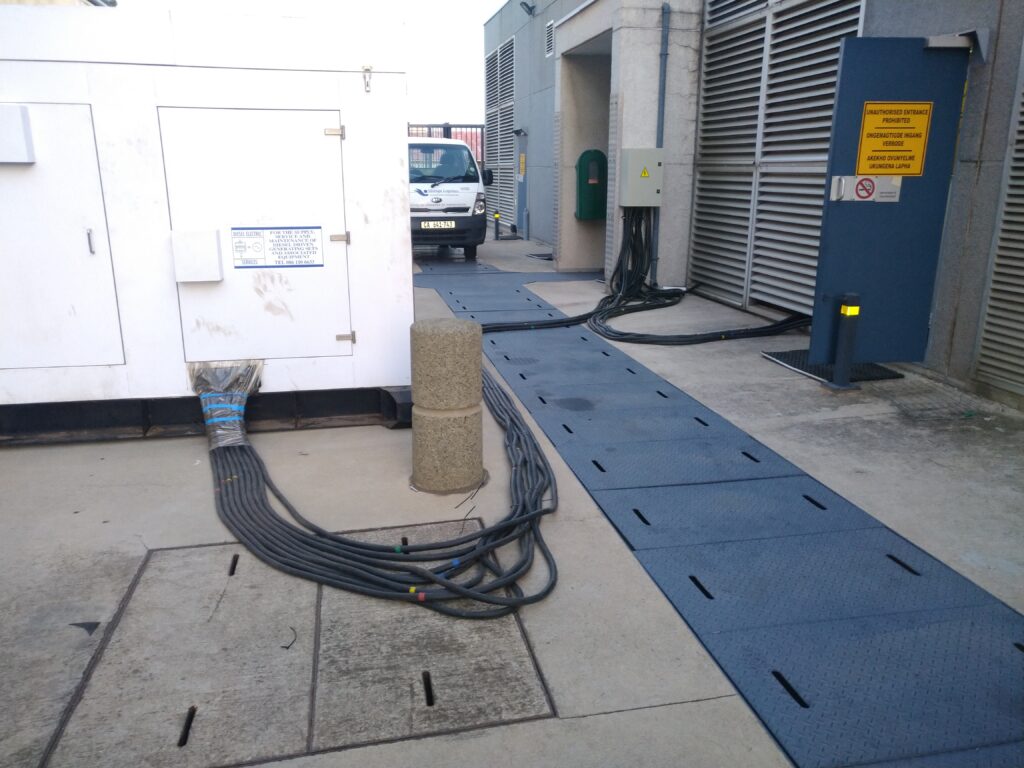
The second incident took place during a period of Stage 6 load shedding when a nationwide diesel shortage had caused suppliers to hold their stock. The contracted diesel supplier for a critical site was unable to deliver. The site had approximately 10 to 12 hours of fuel remaining, with four-hour load-shedding blocks scheduled twice within that window.
Three bakkies, each with a 1,000 litre tank, ran through the night to normal filling stations. Each fill took 20 to 30 minutes. Fifteen thousand litres were delivered to the site before morning. The facility did not go dark.
Neither incident appeared in the maintenance contract scope of work. Both were resolved because the team on the ground understood what was at stake and had the authority, the judgment, and the initiative to act.
The technical credentials matter. CIDB grading, Uptime Institute certification, ECSA-registered engineers: these are the baseline requirements for a data centre maintenance contractor operating at this level.
What the credentials do not tell you is what the team will do at 2am when the system that was never supposed to fail has failed, the client is unreachable, and the decision has to be made right now.
If your current maintenance contractor has not told you a story like either of those above, ask them directly: what is the most critical situation you have had to resolve on a site in the past two years, and what did you do?
The answer will tell you most of what you need to know.
Boron Facilities Management offers a complimentary infrastructure assessment for qualifying sites. We inspect your UPS and battery systems, standby generators, electrical distribution, HVAC, precision cooling, fire detection, and access control. We provide individual reports per asset group within five business days.
No cost. No obligation. No pressure to proceed.